A Swiss-type lathe is not simply a smaller or more advanced CNC lathe. Its defining feature is the sliding headstock, which feeds bar stock through a guide bushing. That support keeps the workpiece close to the cutting tools. For slender parts, this can reduce deflection and help maintain accuracy during turning, drilling, and threading. The difference matters most when a job involves small diameters, long lengths, tight tolerances, or many repeated features. Not every part needs it.
So, why use a swiss type lathe instead of a conventional cnc lathe? The answer often comes down to part geometry and production goals. CNC educator John Saunders is known for practical, process-focused machining guidance. A fair paraphrase of that approach—not a verbatim quotation—is: “Choose the machine for the part, the process, and the required result—not for its reputation.” That principle helps frame the comparison without treating either machine as universally superior.
This guide examines ten reasons shops may choose Swiss-type machining, including workpiece support, cycle efficiency, and the ability to perform multiple operations in one setup. Picture a slender stainless-steel pin held near the cutting zone as tools work from several directions. That arrangement can be valuable. Yet setup, tooling, bar capacity, and operator experience still matter. Swiss-type machines may add complexity and cost, and a conventional CNC lathe can be the better fit for larger, shorter parts. The trade-offs deserve a close look.
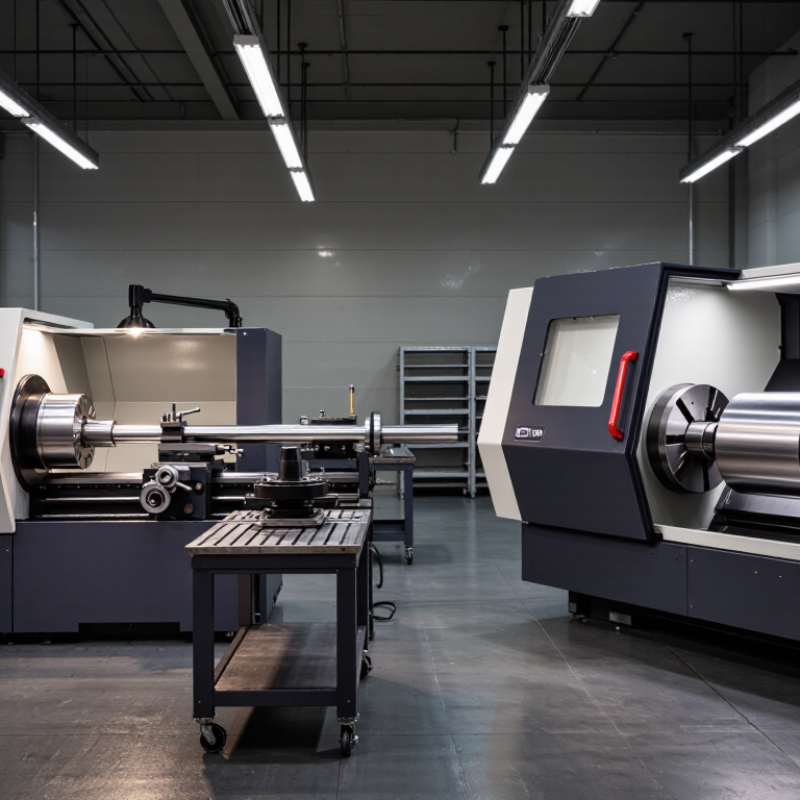
Both Swiss-type and conventional CNC lathes rotate workpieces while cutting tools shape them, but they support the stock differently. A Swiss-type machine feeds bar stock through a guide bushing, keeping the material close to the cutting tool. This support can reduce deflection when machining long, slender parts. A conventional CNC lathe typically holds the workpiece in a chuck, with tools cutting from the exposed end.
That difference affects both machining and setup. On a Swiss-type lathe, the sliding headstock advances the bar as operations proceed, and several tools may work in sequence or at the same time. This can shorten cycle times for small components with multiple features, such as narrow pins with turned steps and cross-holes. Conventional lathes often suit larger or shorter workpieces, and their open chuck setup can make loading and tool access more straightforward.
The comparison is not always tidy. Swiss-type machines may need careful guide-bushing adjustment, compatible bar stock, and more involved programming. Those demands can outweigh cycle-time gains on simple parts or short production runs. Conventional machines can also use driven tools and multiple axes, so the gap depends on the machine configuration. In practice, compare part length, diameter, tolerances, and batch size; a long, thin shaft is a different job from a short, broad fitting. A small setup error can still spoil the first pieces.
| Comparison Dimension | Swiss-Type Lathe | Conventional CNC Lathe | When the Swiss-Type Advantage Matters |
|---|---|---|---|
| 1. Workpiece support | Typically feeds bar stock through a sliding headstock and supports it near the cutting area with a guide bushing. Some models can operate without a guide bushing. | Typically holds the workpiece in a chuck or collet while the headstock remains fixed. Support is generally at the spindle end, with a tailstock or steady rest available where needed. | Useful for long, slender parts that may deflect or vibrate when cutting forces act far from the workholding point. |
| 2. Slender-part machining | The close support near the cutting zone can help control deflection during turning of small-diameter components. | Can machine slender parts, but may require additional support, shorter tool overhangs, or multiple setups depending on part geometry. | Consider Swiss-type machining for pins, shafts, probes, and other parts with a high length-to-diameter ratio. |
| 3. Bar-fed production | Commonly designed for bar work and is often integrated with an automatic bar feeder for extended production runs. | Can also use a bar feeder, but the machine’s spindle, chuck, and workholding arrangement determine its suitability and workflow. | Advantageous when many parts can be produced from bar stock with limited operator intervention. |
| 4. Multiple operations in one cycle | Often equipped with multiple tool stations and, depending on configuration, tools for front- and back-working operations. | Can also combine turning, drilling, milling, and sub-spindle work when equipped with the appropriate live tooling and options. | A Swiss-type machine may reduce handling and secondary operations for complex, small parts when its tooling layout matches the part. |
| 5. Cycle-time potential | Simultaneous or overlapping operations may shorten cycle time for suitable parts, especially when front- and back-working can occur in the same cycle. | Cycle time depends on spindle configuration, tooling, programming, and the number of operations; advanced conventional lathes can also overlap operations. | Compare complete cycle times on the actual part. The machine type alone does not guarantee a faster cycle. |
| 6. Long-part accuracy | Guide-bushing support can help maintain stability close to the cutting tool, supporting consistent machining of long, narrow features. | Accuracy depends on machine condition, workholding, part support, tool setup, thermal control, and the machining process. | Potentially valuable when dimensional consistency on slender features is difficult to maintain with conventional workholding. |
| 7. Bar utilization and remnants | Guide-bushing and machine configuration affect the length of material remaining at the end of a bar; suitable setups can help reduce remnant length. | Remnant length depends on the chuck, spindle, bar feeder, parting approach, and machine design. | Evaluate actual material yield and remnant length for the chosen machine and setup rather than assuming one design always wastes less material. |
| 8. Part size and geometry | Particularly suited to small-diameter, bar-fed components; available capacity varies by machine model and configuration. | Conventional CNC lathes are available across a broad range of capacities and are often better suited to larger diameters, chucking work, and heavier components. | Choose Swiss-type equipment when the part envelope and bar size fall within its capacity and its support method addresses the machining challenge. |
| 9. Setup and process planning | May require careful coordination of guide-bushing adjustment, tool positions, multiple stations, and synchronized operations. | Setup can be more straightforward for basic chucking and turning jobs, though complex machines with live tooling or a sub-spindle also require detailed planning. | Factor in programming, setup time, tooling, and operator skills—not just the expected production cycle. |
| 10. Best-fit production work | Often a strong choice for repeat production of small, precise, slender components made from bar stock. | Often a strong choice for larger parts, chucking work, short-run jobs, and parts that do not benefit from guide-bushing support. | Select the process that best fits the part geometry, batch size, tolerance requirements, material, and total manufacturing cost. |
Note: These are typical differences, not universal rules. Machine capabilities vary, and both Swiss-type and conventional CNC lathes can be configured for a wide range of applications.
It supports the bar close to the cutting tool, shortening the unsupported span. Less flex. Setup still matters.
A simplified estimate gives 0.26 mm of deflection for a 6 mm steel bar with 100 mm unsupported length under 10 N. Halving the span reduces the estimate to about 0.033 mm. Real cutting is messier.
Long pins, miniature shafts, precision spacers, and small connector contacts may benefit. Their slender shapes can flex during cutting.
Yes, if operations can safely overlap. In one example, overlapping 8 seconds cuts a 22-second cycle to 14 seconds. That is not guaranteed.
Front-side work can overlap with drilling or backworking. The part may need fewer transfers and less re-clamping. Fewer handoffs help.
No. Short, chunky parts and low-volume jobs may be more economical on a standard CNC lathe. Compare setup time, batch size, and stock needs.
Depending on the machine and setup, live tooling may produce cross holes, flats, and turned diameters. Tool access can limit the plan.
Run the actual material and dimensions, then check tool wear, chip control, and changeover time. One fast cycle proves little.
Choosing a Swiss-type lathe over a conventional CNC lathe can be especially valuable when producing small-diameter, long, or slender components. Unlike a conventional setup, a Swiss-type machine feeds material through a sliding headstock while supporting it close to the cutting area with a guide bushing. This arrangement helps limit deflection and vibration, which can improve dimensional accuracy and surface finish, particularly on parts that are difficult to support over their full length.
Another advantage is the ability to perform multiple operations simultaneously, reducing cycle time and the need for repeated handling or repositioning. These machines are well suited to high-volume production of intricate, precision parts with tight tolerances, while conventional CNC lathes may remain a practical choice for larger or less slender workpieces. Understanding why use a swiss type lathe instead of a conventional cnc lathe comes down to matching the machine’s support, precision, and production capabilities to the part and manufacturing requirements.

 AcuTek CNC