What is a Photoelectric Sensor and How Does It Work?
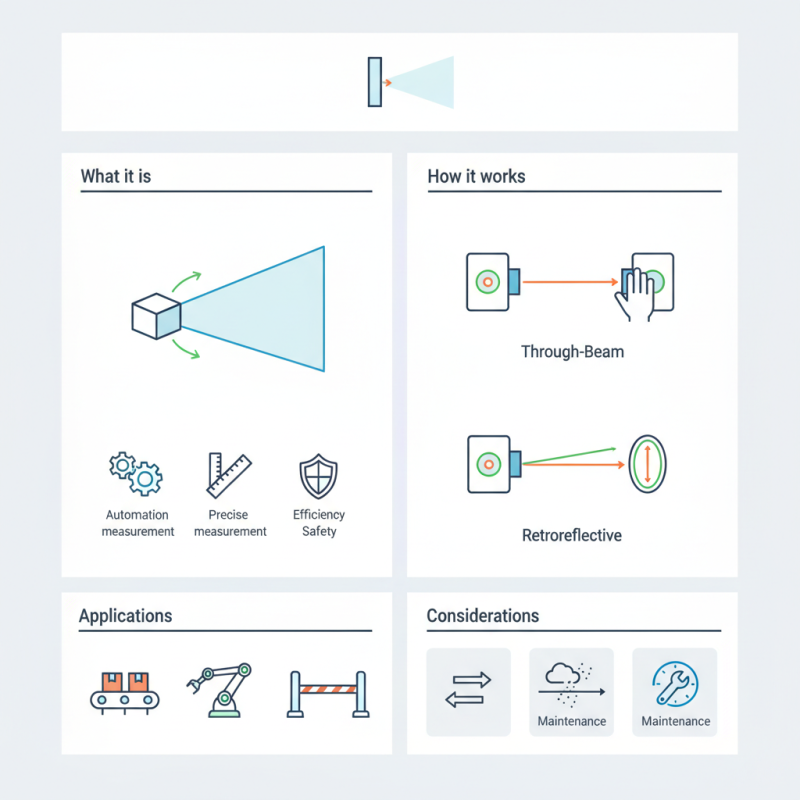
Photoelectric Sensors play a crucial role in modern automation and industrial processes. These devices detect the presence or absence of objects using light. They send signals based on the intensity of reflected light. This technology offers precise measurements, enhancing efficiency and safety.
Understanding how Photoelectric Sensors work is essential. Their functions vary depending on the type, such as through-beam or retroreflective sensors. Each type has specific applications, from simple object detection to complex safety systems. However, realizing their limitations is equally important. For example, environmental conditions can impact their effectiveness.
Photoelectric Sensors are often misunderstood. Some users may overlook the need for proper alignment. Failing to do so reduces their performance. The reliance on light makes them sensitive to dust and dirt. Regular maintenance is key to sustaining their functionality. Through exploration, one might appreciate their value and reflect on the nuances involved.
What is a Photoelectric Sensor? Overview and Applications
Photoelectric sensors are pivotal in modern automation. These devices convert light signals into electrical signals. They are essential in various applications, including packaging, manufacturing, and safety systems. According to a recent industry report, the global photoelectric sensor market is projected to reach $2.3 billion by 2025, indicating robust demand.
In manufacturing environments, photoelectric sensors improve efficiency. They detect the presence or absence of objects. They can trigger alarms or automated responses. For instance, in conveyor systems, these sensors monitor the flow of products. A breakdown in one of these systems can lead to significant downtime. This highlights the importance of choosing reliable sensors.
However, not all photoelectric sensors are created equal. Factors such as environmental conditions or installation angles can affect performance. Some sensors may have a limited range or be prone to false readings due to ambient light. These imperfections demand careful consideration during selection and installation. Organizations must conduct regular assessments to ensure optimal functionality over time.
The Working Principle of Photoelectric Sensors Explained
Photoelectric sensors are fascinating devices used in various automation applications. Their working principle is based on light detection. A typical photoelectric sensor has a light emitter and a receiver. When an object interrupts the light beam, it triggers a response. This process happens quickly, allowing for reliable sensing in different environments.
In operation, photoelectric sensors can be divided into three types: retro-reflective, through-beam, and diffuse. Retro-reflective sensors bounce light off a reflector. This type is useful in smaller spaces. Through-beam sensors send a direct beam from emitter to receiver. They are ideal for long-range detection. Diffuse sensors emit light and detect reflections. However, they may struggle with shiny surfaces. Understanding these nuances helps in selecting the right sensor for specific tasks.
These sensors are not foolproof. Dust and dirt can affect their functionality. Sometimes, the angle of the object can alter detection. Maintenance is essential to ensure optimal performance. Designing a system requires careful consideration of these factors. Balancing precision and practicality is often challenging. Photoelectric sensors teach us that even small details matter significantly in achieving reliable automation.
Types of Photoelectric Sensors: Categories and Use Cases
Photoelectric sensors are vital in automation. They detect objects without direct contact. Let’s explore the various types in use today.
There are three main types of photoelectric sensors: reflective, through-beam, and proximity. Reflective sensors send out a beam and register the reflection from nearby objects. According to a recent industry report, reflective sensors have seen a 25% increase in demand. They’re widely used in packaging lines. Through-beam sensors emit light from one unit to another. They create a precise detection zone. Companies favor them for applications requiring high accuracy. Proximity sensors, on the other hand, detect objects within a certain range. They’re commonly found in elevators and security systems.
Tip: Proper installation of photoelectric sensors is essential for accuracy. Misalignment can lead to false readings. Regular maintenance can further enhance performance. Also, consider environmental factors. Dust or fog can obscure detection capabilities.
In industries like automotive and manufacturing, these sensors are indispensable. However, their sensitivity can be a double-edged sword. Excessively high sensitivity may lead to unintended triggers. Balancing sensitivity and reliability is crucial for optimal use.
What is a Photoelectric Sensor and How Does It Work? - Types of Photoelectric Sensors: Categories and Use Cases
| Sensor Type | Working Principle | Common Use Cases | Advantages | Disadvantages |
| Through-beam Sensor | Emits a beam of light from a transmitter to a receiver | Object detection in packaging, labels | High detection accuracy, long range | Requires alignment, sensitive to ambient light |
| Reflex Sensor | Uses a reflector to bounce back the emitted light | Conveyor systems, automatic doors | Easy installation, no need for alignment | Short detection range, reliance on reflector |
| Diffuse Sensor | Detects light reflected from the object itself | Packaging, product counting | Versatile, can detect various colors and materials | Limited range, less effective on shiny surfaces |
| Laser Sensor | Utilizes a laser beam for precise measurements | Distance measurement, object detection | High accuracy, long-range capabilities | Higher cost, requires maintenance |
Key Specifications and Performance Metrics of Photoelectric Sensors
Photoelectric sensors are crucial in automation and industrial applications. These devices detect objects by emitting light and measuring the reflected signal. Various specifications help users choose the right sensor for their needs. The sensing range typically varies from a few centimeters to several meters. It is vital to consider this range for optimal device performance.
Response time is another critical metric. Most photoelectric sensors operate within milliseconds. Some advanced models can respond even faster, under 1 millisecond. Light type—infrared, visible, or laser—also affects sensor performance. According to industry reports, sensors with laser technology can detect smaller objects compared to those using infrared light.
Power consumption is an important factor too. Low-power sensors are available, which are energy-efficient. However, their sensitivity might be lower. Noise immunity is a common concern; certain environments may introduce interference. Users must assess their specific conditions when selecting a sensor. Often, trade-offs exist between cost, speed, and accuracy. Balancing these elements can be challenging but necessary for effective applications.
Industrial Applications: How Photoelectric Sensors Enhance Automation
Photoelectric sensors play a crucial role in industrial automation. They detect changes in light and convert these changes into electronic signals. This ability enhances efficiency on production lines. According to industry reports, 70% of companies now use these sensors for tasks like object detection and counting.
In automated environments, photoelectric sensors provide real-time feedback. They can detect a presence without physical contact. This contactless operation reduces wear and tear, prolonging equipment life. A study indicated that industrial facilities saw a 25% drop in downtime after implementing these sensors. However, they are not infallible. Environmental factors, like dust or fog, can interfere with their performance.
Integrating these sensors into existing systems can be a challenge. Some companies report difficulties in calibration and alignment. Training staff is also necessary, which requires time and resources. While photoelectric sensors significantly enhance automation, understanding their limitations is essential. Ensuring optimal performance means regular maintenance and testing against environmental changes.
Photoelectric Sensor Types and Their Industrial Applications
This chart illustrates the various types of photoelectric sensors used in industrial automation, showcasing their applications and respective market adoption rates.
 +49 (0) 3722 59863-0
 sale@acutekcnc.com